GEO Keyword Research & Query Fan-Out: Operational Guide 2026

68% of pages cited in AI Overviews were NOT in the top 10 organic results. This Surfer SEO data (December 2025, 173,902 URLs analyzed) overturns the foundational assumption of traditional keyword research: ranking on page one is no longer the necessary condition for visibility.
The "one keyword, one page" model is dead. When a user enters a query in Google AI Mode or any AI search engine, the system doesn't search for a single page that answers the question. It breaks it into 6-20 parallel sub-queries, retrieves fragments from dozens of different sources, and synthesizes a unique response. This is called query fan-out, and it makes keyword research as we know it obsolete.
In this article, I analyze the technical mechanics of fan-out, the keyword research methodology specific to GEO, data on AI citations by platform, and operational tools to build content that AI engines actually cite. Numbers, not buzzwords.
How query fan-out works
Query fan-out is the mechanism by which AI search systems break a single user question into multiple parallel sub-queries, retrieve information from different sources for each, then synthesize everything into a coherent response. Google formalized this in patent US12158907B1 "Thematic Search", granted December 2024.
The technical pipeline
When you enter a query in Google AI Mode or ask an LLM with web access, your question goes through a five-phase pipeline:
- Intent Parsing: system analyzes query and identifies primary and implicit secondary intents.
- Query Rewriting: original query reformulated into more specific variants, disambiguating ambiguous terms.
- Fan-Out / Decomposition: query broken into 6-20 parallel sub-queries, each targeting a different aspect of the question.
- Parallel Retrieval: each sub-query executed simultaneously against the index, retrieving text chunks (not full pages) from diverse sources.
- Chunk Scoring & Synthesis: retrieved fragments evaluated for relevance, authority, and coherence, then synthesized into unique response with citations.
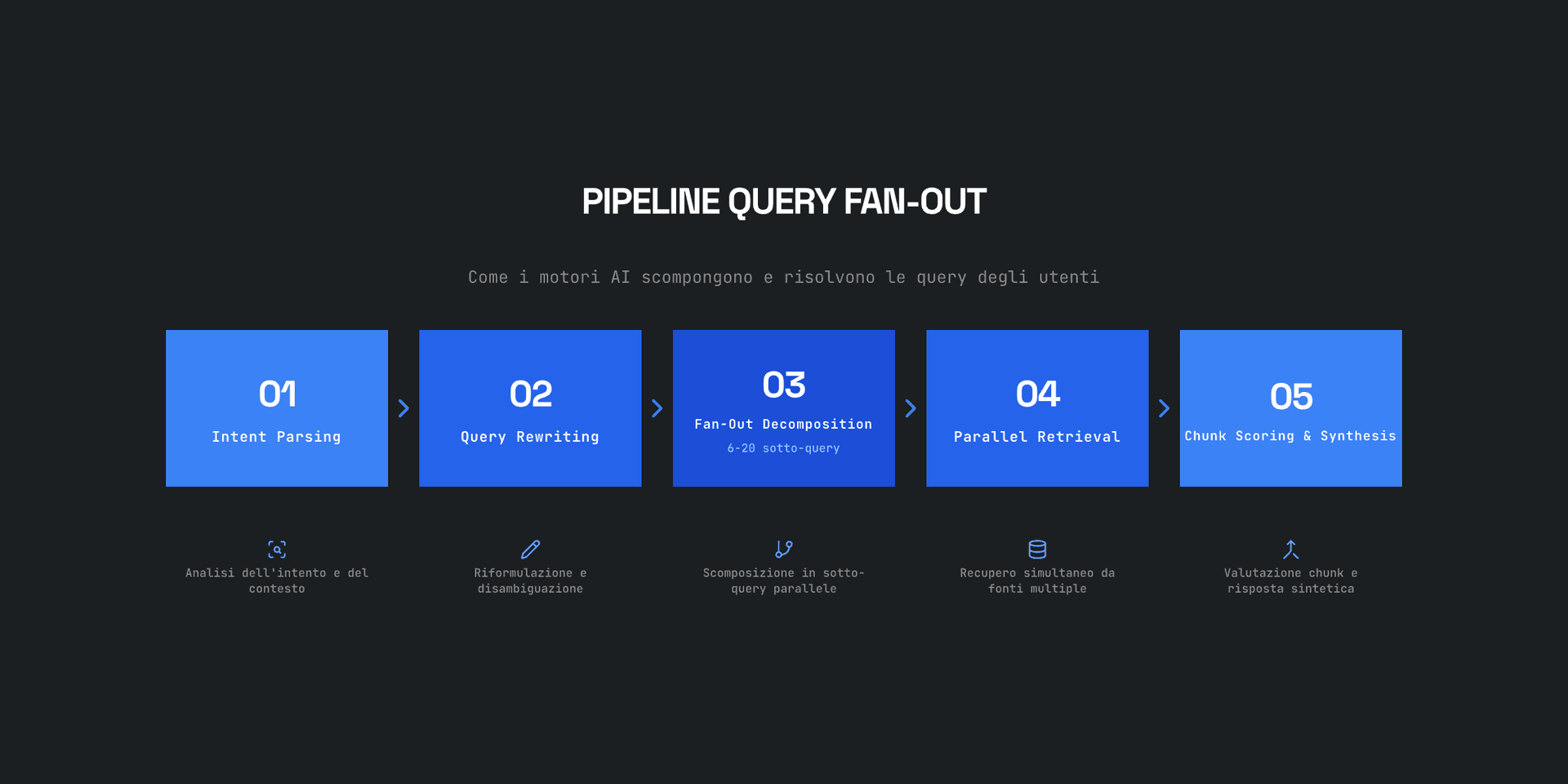
The key point: LLMs retrieve at PARAGRAPH level, not page level. Your page may be 5,000 words, but the system extracts only the 100-200 word chunk answering a specific sub-query. Each section of your content must work as an autonomous unit.
Practical example of fan-out
Imagine a user searches: "how to choose an SEO consultant in Brescia for my e-commerce". The system might break this into sub-queries like:
- What does an SEO consultant do? (definition)
- SEO consultant vs agency: differences (comparison)
- How to evaluate an SEO consultant's skills (how-to)
- SEO consultant for e-commerce: specific skills (use case)
- How much does an SEO consultant cost in Brescia (metric)
- Mistakes to avoid when choosing an SEO consultant (objection)
- SEO consultants Brescia: available specializations (entity expansion)
Each sub-query pulls from different sources. Your page might be cited for only one or two of these sub-queries—it's not necessary (or possible) to dominate them all with one piece. You need a strategy covering the full topic cluster.
The instability of sub-queries
A fundamental data point (SimilarWeb): only 27% of sub-queries remain consistent across different searches of the same query. This means fan-out isn't deterministic. The same question asked at different times generates partially different sub-queries. Consequence for keyword research: you can't optimize for one sub-query—you must cover the entire semantic space of the topic.
GEO keyword research vs traditional keyword research
Traditional keyword research starts with search volume and keyword difficulty to select specific targets. GEO keyword research starts with the semantic space that fan-out could generate and tries to cover it as fully as possible. Two complementary approaches with very different logic.
| Dimension | Traditional SEO | GEO keyword research |
|---|---|---|
| Unit of analysis | Single keyword | Topic cluster + fan-out mapping |
| Primary metric | Monthly search volume | Fan-out semantic coverage |
| Goal | Top 10 SERP position | Being cited in AI response |
| Target query type | Short-tail and long-tail | Conversational anchor queries (15-25 words) |
| Keyword density | Optimal density (1-2%) | Keyword stuffing WORSENS AI visibility |
| Content format | Full-length optimized page | Independent chunks ~800 tokens each |
| Competition analysis | Top 10 SERP analysis | Cross-platform citation analysis (ChatGPT, Perplexity, AIO) |
| Update frequency | When losing positions | Every 2 months (freshness signal for LLMs) |

The most counterintuitive data: keyword stuffing worsens visibility in AI responses. The Princeton GEO study showed that over-optimization for keywords produces results below baseline. LLMs prefer natural language and broad semantic coverage.
Another data point that upends certainties: 25% of URLs most cited by ChatGPT have ZERO organic visibility on Google (SEOClarity). And only 12% of URLs cited by LLMs rank in Google's top 10 (Status Labs). The correlation between traditional ranking and AI citation is weak and declining.
The FAN methodology: operational framework for GEO keyword research
SimilarWeb developed a practical framework for keyword research oriented to GEO, based on analysis of millions of queries and their fan-outs. It's called the FAN methodology: Fan-Out Mapping, Authority-Signal Alignment, Node Architecture.
F — Fan-Out Mapping
First step is mapping the complete space of sub-queries before creating any content. Don't start with the main keyword: start with the question a user would ask an AI assistant.
Conversational anchor queries are the starting point. Instead of "SEO consultant Brescia" (3 words, Google style), the query becomes "how to choose an SEO consultant in Brescia for my e-commerce furniture business" (15-20 words, LLM style). This is how people interrogate LLMs.
Once you define the anchor query, you map the 7 types of sub-queries that fan-out could generate:
- Definition: what is X, what does Y mean—LLM needs to establish context
- Comparison: X vs Y, differences between A and B—comparative questions implicit in the query
- How-to: how to do X, steps for Y—the procedural component
- Use case: X for [specific sector/situation]—response verticalisation
- Objection: risks of X, common mistakes, what to avoid—LLM balances response
- Entity expansion: related entities, alternatives, variations—context broadening
- Metric: how much X costs, timelines for Y, ROI of Z—quantitative data
A — Authority-Signal Alignment
Once fan-out is mapped, second step aligns the authority signals that guide LLM source selection. The Princeton study quantified the impact of each signal:
- Statistics and concrete data: +41% AI response visibility. Every key claim must have a number and source.
- Citations of authoritative sources: +28% (Subjective Impression metric). Cite studies, papers, official reports.
- Fluency + statistics combined: +5.5% additional vs any single strategy. Combination wins.
- Keyword stuffing: BELOW baseline. Over-optimization counterproductive in GEO.
In practice: each section of your content must contain at least one quantitative data point with source, natural language (not keyword-optimized), and references to verifiable primary sources.
N — Node Architecture
Last pillar concerns content structure. Each section must be independently retrievable by fan-out— the LLM must extract a chunk without reading the rest of the page.
Operational rules of Node Architecture:
- Each H2 opens with direct answer of 30-60 words summarizing the section's key point.
- Optimal chunks of ~800 tokens (~600 words). Too short: insufficient context. Too long: LLM cuts and loses information.
- Each section contains at least one quantitative data point with source in parentheses.
- Headings phrased as implicit questions: "How query fan-out works" better than "Query fan-out".
- No dependency on prior context: avoid "as we saw above" or "in the previous paragraph".
AI citations by platform: who cites what
Not all AI engines cite the same sources. Each platform has different biases, and effective GEO strategy must be platform-aware. Here's data current as of March 2026.
| Platform | Source #1 | Citations per response | Key data |
|---|---|---|---|
| ChatGPT | Wikipedia/encyclopedic (47.9%) | 7.92 | 87% citations align with top Bing results |
| Perplexity | Reddit (46.7%) | 21.87 | Proprietary index 200B+ URLs, most generous in citations |
| Google AIO | YouTube (23%) | 7.2 (avg) | 68% of sources NOT in top 10 organic |
| Copilot | Bing sources | 2.47 | Least generous in citations among all platforms |

Data highlighting fragmentation: only 11% of domains cited by both ChatGPT and Perplexity. Being visible on one platform doesn't guarantee visibility on others. GEO keyword research must consider the mix of platforms relevant to your target audience.
Where early paragraphs matter most
44.2% of citations come from the first 30% of text. Introduction and early paragraphs have disproportionate weight in source selection. Direct answer at the start of each section isn't a style suggestion—it's a measured GEO ranking factor.
This has direct implications for content structure: the answer to the main question must appear in the first 40-60 words, not after three paragraphs of context. LLMs don't read all pages with equal attention—they weight the beginning more heavily.
Surfer SEO study: fan-out numbers
The most complete study on the relationship between fan-out and AI citations was published by Surfer SEO in December 2025, based on analysis of 173,902 URLs and 33,000 fan-out sub-queries generated by Google AI Mode.
Key findings
- 161% higher citation probability: pages ranking for fan-out sub-queries are 2.6x more likely to be cited in AI response vs pages ranking only for main query.
- Spearman correlation 0.77: between fan-out coverage and citation probability. Strong correlation—more sub-queries covered, more cited.
- 68% of cited pages NOT in top 10: traditional organic ranking no longer prerequisite for AI visibility.
- Sub-queries unstable: only 27% remain consistent across searches (SimilarWeb). Broad coverage beats precise optimization.
The operational lesson is clear: keyword research for GEO shouldn't search for the perfect keyword to rank top 10. It must map the entire spectrum of possible sub-queries and create content covering as many as possible. Semantic coverage beats precise positioning.
Implications for content strategy
These data suggest a paradigm shift in content strategy. Instead of creating one page optimized for one target keyword, the winning strategy is building complete topic clusters where:
- The pillar page covers the main query and definition/comparison sub-queries
- Satellite pages cover how-to, use cases, and metric-specific queries
- Internal links connect everything in a coherent semantic graph
- Each page contains self-contained chunks extractable by fan-out
Fan-out impact on CTR and organic traffic
Fan-out doesn't just change how content is selected— it radically changes user behavior after search. Here are the latest data on click-through rate impact.
| Study | Metric | Impact |
|---|---|---|
| Seer Interactive (3,119 KW) | Organic CTR with AIO | -61% (from 1.76% to 0.61%) |
| Ahrefs (Dec 2025) | CTR position #1 with AIO | -58% |
| SparkToro/Datos | Zero-click with AIO | 83% (vs 60% without AIO) |
| Seer Interactive | CTR for sites cited INSIDE AIO | +35% vs non-cited |
| Adobe/Superlines | AI referral traffic YoY | +357% (but <1% of total) |
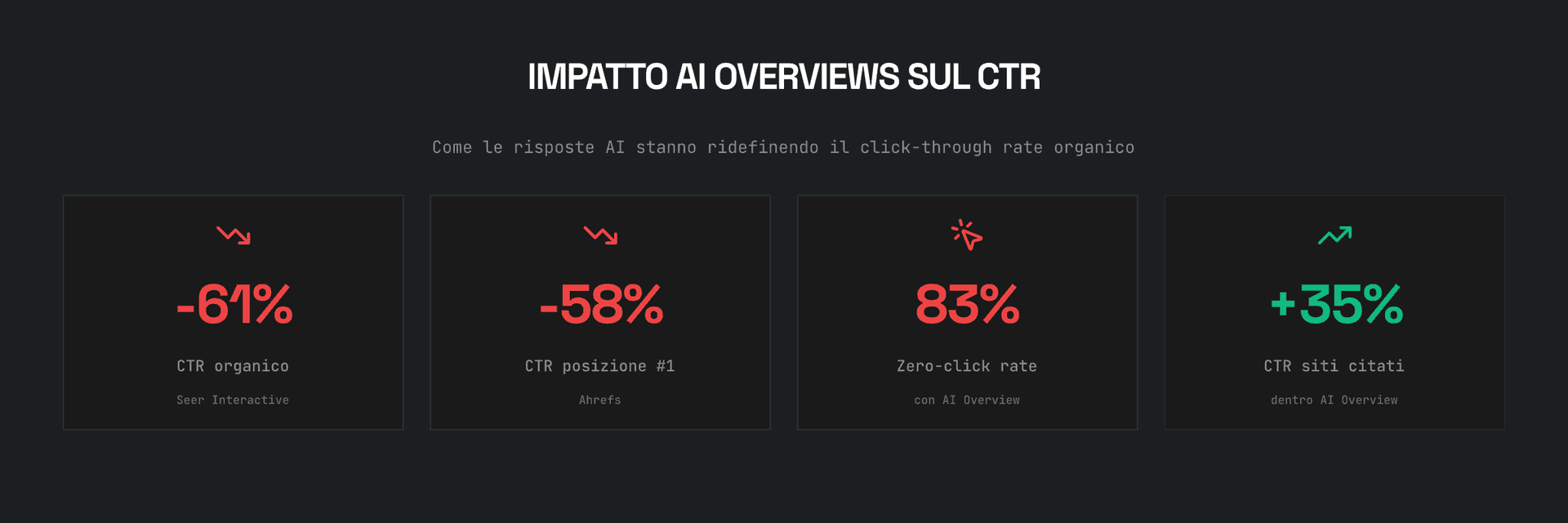
The AI visibility paradox: CTR crashes for those not cited, but rises for those inside the response. AI Overview isn't just a competitor stealing clicks—it's a new distribution channel. The difference between being cited and not is huge: +35% CTR for sites cited inside AI responses (Seer Interactive).
AI platform referral traffic is still marginal in absolute terms— less than 1% of total web. But it's growing at exponential rates: +357% year-over-year per Adobe. And there's important qualitative data: visitors from AI platforms convert at double the rate of traditional search users and spend 68% more time on sites they visit.
Strategic conclusion: fan-out makes AI visibility a non-zero-sum game. Those covering sub-queries and getting cited not only maintain traffic—they get better users. Those ignoring fan-out lose visibility both in traditional SERPs (for CTR decline) and in AI responses.
Tools for GEO keyword research
A new ecosystem of tools is emerging to support keyword research oriented to fan-out and monitoring AI citations. Here are the main ones as of March 2026, from free to enterprise.
| Tool | Price | Primary function | Notes |
|---|---|---|---|
| Qforia (iPullRank) | Free | Fan-out simulator | Shows how LLM decomposes your query into sub-queries. Ideal starting point. |
| HubSpot AI Search Grader | Free | Brand AI visibility | Entry-level diagnostics on ChatGPT, Perplexity, Gemini. |
| Otterly.AI | From $25/month | AI citation monitoring | Google AIO, Perplexity, ChatGPT. 20,000+ users. |
| Semrush AI Visibility Toolkit | $199/month | Integrated AI visibility | Includes fan-out analysis. US only for now. |
| Ahrefs Brand Radar | ~$199/month | Brand mentions in LLMs | Tracks where and how your brand cited by AI. |
| Profound | From $499/month | Enterprise AI visibility | Market leader, 10+ AI engines. $35M Series B from Sequoia. |
How to use Qforia for fan-out mapping
Qforia by iPullRank is the most accessible tool for starting fan-out mapping. It's free and simulates the query decomposition process:
- Enter your conversational anchor query (15-25 words).
- Tool generates likely sub-queries an LLM would produce.
- For each sub-query, analyze which sources are currently cited.
- Identify gaps: sub-queries where you lack content or yours isn't cited.
- Create or update content to cover identified gaps.
Important caveat: all LLM tracking tools are "fundamentally limited" (Lily Ray) because AI responses are non-deterministic and personalized. Same prompt can generate different citations at different times. Use them as trend indicators and for gap identification, not as absolute metrics.
Operational checklist: from research to publication
Translating theory into practice requires structured process. Here's the four-phase checklist for implementing GEO keyword research in your content creation workflow.
Phase 1 — Research
- Define 3-5 conversational anchor queries (15-25 words) for your topic.
- Use Qforia or manually simulate fan-out: for each anchor query, map 7 sub-query types (definition, comparison, how-to, use case, objection, entity expansion, metric).
- Run gap analysis: for each sub-query, verify if you have content covering it and if that content gets cited.
- Analyze cross-platform citations: what do ChatGPT, Perplexity, Google AIO cite for your sub-queries?
- Identify sub-queries uncovered by competitors—highest potential opportunities.
Phase 2 — Creation
- Each H2 opens with direct answer of 30-60 words.
- Chunks of ~800 tokens (~600 words) per section—each self-contained.
- At least one statistic with source every 150-200 words.
- Natural language: no keyword stuffing, no forced repetition.
- Headings phrased as implicit questions matching mapped sub-queries.
- Primary sources cited inline: studies, papers, official reports with links.
Phase 3 — Technical optimization
- JSON-LD schema markup: Article, FAQPage, HowTo, Organization—pages with schema have 2.8x more AI citations.
- Cross-platform optimization: verify AI crawlers (ChatGPT-User, PerplexityBot, Claude-SearchBot) can access content.
- Topic cluster with coherent internal links: pillar page linked to satellites and vice versa.
- Meta description optimized for click from AI response, not just SERP.
Phase 4 — Monitoring
- Citation frequency: how often your content cited in AI responses (Otterly.AI or HubSpot AI Search Grader to start).
- Brand mention rate: percentage of relevant queries where your brand appears in AI responses.
- Fan-out coverage score: percentage of mapped sub-queries for which you have cited content.
- Freshness: update content every 2 months—LLMs privilege recent content with visible timestamp.
From keyword to semantic coverage: the new paradigm
Keyword research for GEO isn't an incremental evolution of traditional keyword research— it's a paradigm shift. The unit of analysis is no longer single keywords but the semantic space that fan-out generates around a topic. The goal is no longer SERP position but probability of being cited in AI responses.
Data is unambiguous: 0.77 correlation between fan-out coverage and citation (Surfer SEO), 161% higher probability for sub-query coverage, 68% of cited pages outside top 10. Those continuing keyword research only for traditional ranking are optimizing for a system generating fewer and fewer clicks.
The good news: foundations are the same as well-done SEO. Structured content, concrete data, real expertise, clear answers. The FAN methodology adds systematic layer to cover fan-out space and maximize citation probability. Not an alternative to SEO—its necessary complement.
For the full GEO, AI Overviews, and AI content strategy 2026 picture, read the GEO and AI Overviews guide.
SEO fundamentals in 2026, from technical to strategy, in the SEO 2026 guide.
Structured data is a GEO multiplier: learn how in the structured data and Schema.org guide.
To implement GEO keyword research for your project, contact me for personalized consulting.
Frequently asked questions
What is query fan-out and why is it important for SEO?
Query fan-out is how AI search engines break a single query into 6-20 parallel sub-queries, retrieve fragments from different sources, and synthesize unique response. Important because it radically changes how content gets selected: no longer just top-10 ranking for main keyword, but coverage of entire semantic sub-query space. Pages covering fan-out sub-queries are 161% more likely to be cited (Surfer SEO).
How do you do keyword research for GEO?
Start with conversational anchor queries 15-25 words (how people ask LLMs), map fan-out into 7 sub-query types (definition, comparison, how-to, use case, objection, entity expansion, metric), run gap analysis to identify uncovered sub-queries, create structured content in ~800-token self-contained chunks with statistics, sources, direct answers at section start.
Is traditional keyword research still useful?
Yes, but no longer sufficient alone. Traditional keyword research (volume, difficulty, intent) remains essential for organic SERP ranking, which still generates bulk of traffic. But 68% of AI Overview cited pages weren't in top 10, and only 12% of LLM-cited URLs rank top-10. Integrate classic keyword research with fan-out mapping to cover both channels.
What tools do I need to monitor AI visibility?
To start: Qforia (free) for fan-out simulation, HubSpot AI Search Grader (free) for basic diagnostics. For structured monitoring: Otterly.AI (from $25/month) tracks citations on Google AIO, Perplexity, ChatGPT. For enterprises: Semrush AI Visibility ($199/month) or Ahrefs Brand Radar (~$199/month). Enterprise: Profound (from $499/month). All have limits—AI responses non-deterministic—use as trend indicators.
How often should you update content for GEO?
Every 2 months as baseline rule. LLMs privilege content with recent timestamp and freshness signals. No need to rewrite everything: update data, add new sources, integrate new sub-queries discovered from fan-out monitoring. Fan-out coverage isn't static—sub-queries evolve over time (only 27% consistent), so content must evolve with them.
Does query fan-out work in Italy?
Yes. Fan-out mechanics are language-independent—it's system architecture, not local feature. AI Overviews active in Italy since March 2025 (logged-in users 18+ only). ChatGPT, Perplexity, Copilot already operating in Italian. Difference vs English-speaking markets: less competition—few Italian sites optimizing for GEO, which represents opportunity for movers-first.
Frequently Asked Questions
Query fan-out is how AI engines break a query into 6-20 sub-queries, retrieve fragments from different sources, and synthesize response. Pages covering fan-out sub-queries are 161% more likely cited in AI responses (Surfer SEO).
Start with conversational anchor queries (15-25 words), map fan-out into 7 sub-query types, run gap analysis, create content in ~800-token self-contained chunks with statistics, sources, direct answers at section start.
Yes, but no longer sufficient alone. Traditional keyword research remains essential for organic ranking. But 68% of AI-cited pages weren't top 10, only 12% rank top-10. Integrate classic research with fan-out mapping.
Free: Qforia (fan-out simulation), HubSpot AI Search Grader (diagnostics). Paid: Otterly.AI ($25/month), Semrush AI Visibility ($199/month), Ahrefs Brand Radar (~$199/month). Enterprise: Profound ($499/month). Use as trend indicators.
Every 2 months baseline. LLMs privilege recent timestamp and freshness. Update data, add sources, integrate new sub-queries. Only 27% of sub-queries stay consistent—content must evolve with them.
Yes, fan-out is language-independent system architecture. AI Overviews active since March 2025 (logged-in 18+ only). ChatGPT, Perplexity, Copilot in Italian. Less competition—opportunity for early movers.
About the author

Claudio Novaglio
SEO Specialist, AI Specialist e Data Analyst con oltre 10 anni di esperienza nel digital marketing. Lavoro con aziende e professionisti a Brescia e in tutta Italia per aumentare la visibilità organica, ottimizzare le campagne pubblicitarie e costruire sistemi di misurazione data-driven. Specializzato in SEO tecnico, local SEO, Google Analytics 4 e integrazione dell'intelligenza artificiale nei processi di marketing.
Want to improve your online results?
Let's talk about your project. The first consultation is free, no commitment.